
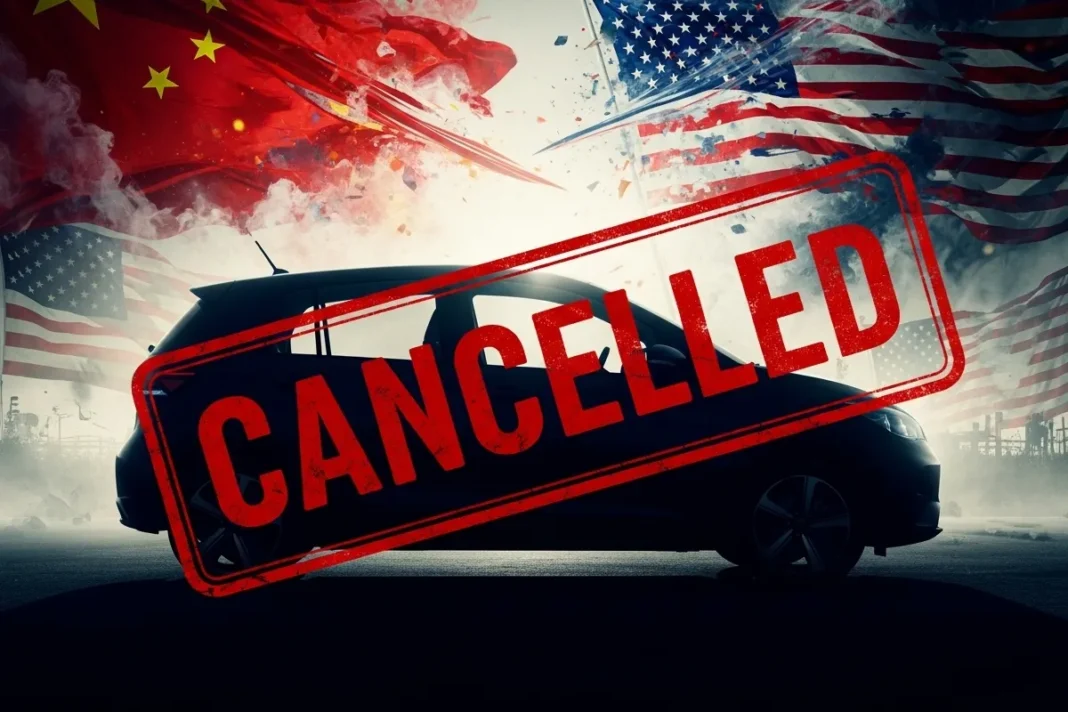
Explore the intense EV price war in China and its ripple effects across the globe, leading to Tesla’s strategic shift away from the budget-friendly Model 2. This article will analyze the “involution” crippling the Chinese EV market, the oversupply issues, and how this competitive pressure forced Tesla to abandon its plans for a $25,000 car, instead focusing on a cheaper Model Y.
Table of Contents
Introduction
The Tesla Model 2 wasn’t just a car; it was a promise. And like many promises in the cutthroat world of global industry, it was broken before it was ever truly made. The official eulogies will point to shifting priorities or a visionary focus on autonomy. Still, the truth is far simpler and more brutal: the Tesla Model 2 is a casualty of a war it never even had a chance to fight. It was executed in absentia by the sheer ferocity of China’s EV price war, a conflict so intense it has fundamentally rewritten the rules of the automotive world. This article is a post-mortem. We are not here to mourn a canceled product, but to analyze a strategic surrender. We will dissect how the hyper-competitive “involution” crippling the Chinese EV market created a financial meat grinder so vicious that it made the very concept of a profitable $25,000 Tesla Model 2 an economic impossibility.
Our analysis will begin by revisiting the genesis of the dream—the ghost of the Tesla Model 2 and its foundational role in the company’s original master plan. We will then plunge into the Dragon’s Gauntlet, detailing the price war bloodbath and the unwinnable financial math that turned the project from a guaranteed hit into a margin-destroying liability. From there, we will examine Tesla’s great pivot, the strategic retreat from affordable hardware to a high-risk bet on the Robotaxi, effectively conceding the mass market. Finally, we will assess the global fallout, exploring what a world without an affordable Tesla Model 2 means for legacy automakers, the EV market, and consumers who were promised a revolution that has yet to arrive. This is the story of how the most anticipated affordable EV in a generation was killed by the market before it was ever born.
The Genesis and Ghost of the Tesla Model 2: A Dream Deferred, Then Destroyed
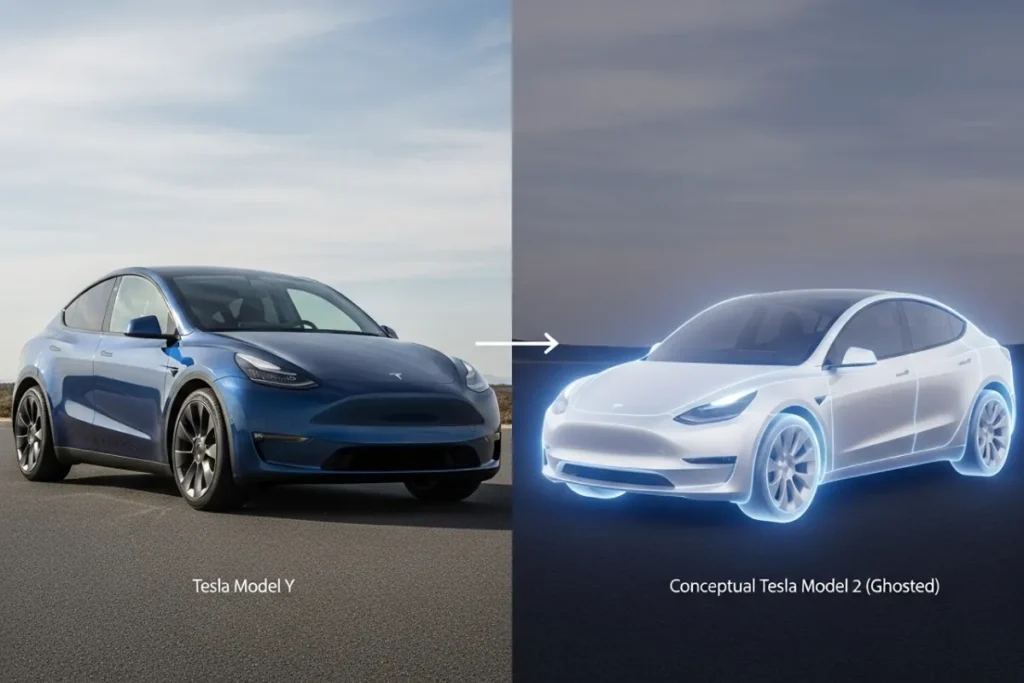
The Tesla Model 2 was never just another car on a product roadmap; it was the prophecy. This was supposed to be Elon Musk’s “Volkswagen” moment—the final, triumphant piece of his Master Plan designed to put a Tesla in every driveway. The vision was intoxicatingly simple: a globally accessible, $25,000 electric vehicle that would unlock colossal volume in price-sensitive markets from Europe to India, and most critically, in China. The hype wasn’t just fan-driven; it was a core promise that set the entire industry’s expectations. The arrival of an affordable Tesla Model 2 was treated as an inevitability, the moment the EV revolution would become truly democratized by its most iconic brand. For years, the question wasn’t if the Tesla Model 2 would happen, but how quickly it would dominate.
This vehicle wasn’t a passion project; it was the mathematical linchpin of Tesla’s entire long-term strategy. The audacious goal of selling 20 million vehicles annually by 2030 is utterly impossible without a mass-market car. The Model 3 and Y, despite price cuts, remain premium products out of reach for the majority of global car buyers. The Tesla Model 2 was the foundational pillar intended to support that exponential growth. It was the key to transitioning Tesla from a high-end disruptor into a true automotive superpower on the scale of Toyota or VW. Without the Tesla Model 2, that 20-million-car target isn’t just a missed goal; it’s a strategic fantasy.
The protracted, confusing saga of its demise should have been the ultimate red flag. The slow drip of information, the vague “Project Redwood” codename, and the eventual stark reports of its cancellation were not the signs of a project facing engineering hurdles. This was the public record of a company growing increasingly terrified of the very market it sought to conquer. Each delay and vague statement was a hesitation, a flinch in the face of an economic reality that was becoming uglier by the quarter. The slow, painful death of the Tesla Model 2 wasn’t a surprise; it was the death rattle of a brilliant idea that was killed by the market long before the first blueprint was ever finalized.
The Dragon’s Gauntlet: China’s “Involution” and the Price War Bloodbath
To understand why the Tesla Model 2 was dead on arrival, one must first understand the brutal market dynamic known as “involution” (内卷, nèijuǎn). This isn’t your typical Western-style competition; it’s a zero-sum death spiral. Involution is a state of intense, hyper-competitive internal struggle where companies expend monumental effort—slashing prices, bloating feature lists, accelerating model cycles—only to achieve diminishing returns. It’s a race to the bottom with no finish line, a meat grinder that pulverizes profit margins and suffocates innovation in favor of sheer survival. This was the hostile environment awaiting the launch of a new, supposedly affordable Tesla Model 2—a market designed to bleed newcomers dry before they can gain a foothold.
The chief executioner in this price war is BYD. While Tesla was still theorizing about a $25,000 car, BYD weaponized its vertical integration and government-backed scale to launch the Seagull hatchback for under $10,000 in China. This single move fundamentally reset the definition of “affordable.” It made a $25,000 entry point from a foreign brand look not just expensive, but laughably out of touch. The brutal math became clear: BYD and its peers could sell three of their EVs for the price of one hypothetical Tesla Model 2. In this context, the Tesla Model 2 was strategically outmaneuvered and financially checkmated years before it could even be revealed.
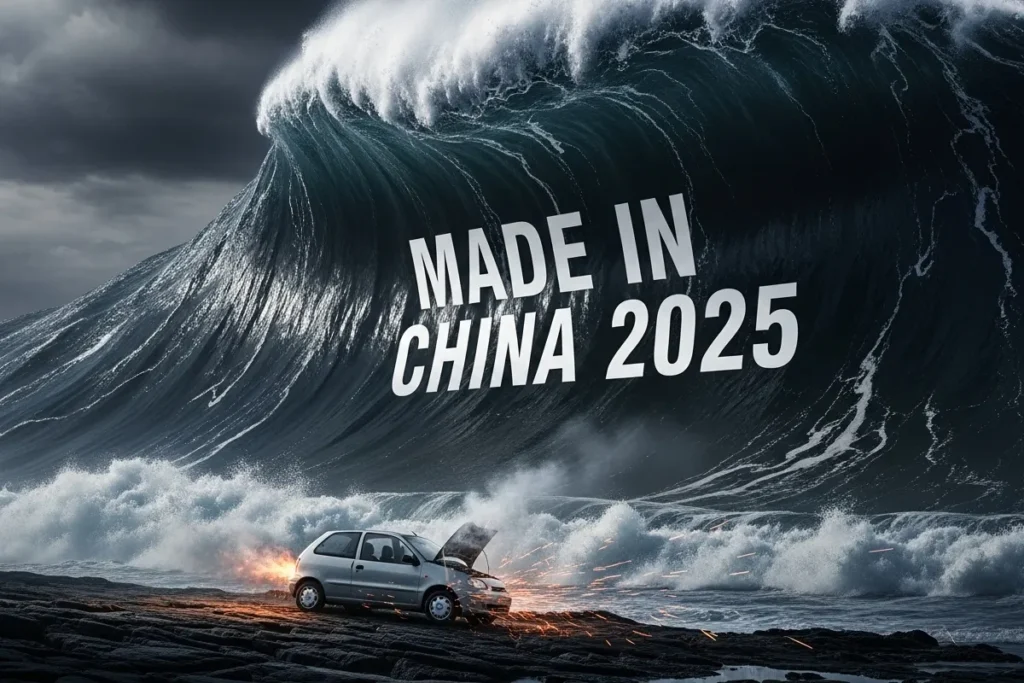
This race to the bottom is supercharged by a staggering oversupply crisis. Decades of aggressive state subsidies created a tsunami of EV production capacity, spawning dozens of manufacturers—many of them “zombie” companies—all fighting over the same pool of customers. This created a glut of inventory and an environment of pure desperation. To simply move metal, these companies initiated a pricing bloodbath that has left the entire low-end market a smoldering crater of unprofitability. For Tesla, launching the Tesla Model 2 would have meant jumping into this toxic swamp, a move that would have been financially suicidal and strategically insane.
The Unwinnable Math: Why the Tesla Model 2 Was a Financial Non-Starter
Even if Tesla had the stomach for China’s brutal price war, the internal math for the Tesla Model 2 was simply unwinnable. The core of Tesla’s identity is that of a high-margin tech company, not a low-cost volume manufacturer. Despite its Gigafactories, its fundamental cost structure for R&D, software engineering, and corporate overhead is based in California. This is a world away from a vertically integrated behemoth like BYD, which owns its battery supply chain and operates with Chinese-level costs. For Tesla to produce a globally competitive Tesla Model 2 for $25,000 while retaining a respectable profit margin was a financial fantasy. It would have been a margin massacre, a vanity project chasing volume that would have been celebrated by fans but abhorred by Wall Street for annihilating the company’s profitability.
The financial danger wasn’t just external; it was a threat from within. A cheap Tesla Model 2 would have been an act of commercial self-sabotage. Its biggest and most immediate victim would not have been a competitor, but Tesla’s Model 3. Why would a customer on the fence pay over $40,000 for a Model 3 when a shiny new Tesla Model 2 offering a similar badge and tech experience sits in the showroom for thousands less? This is the classic cannibalization trap: sacrificing high-margin sales for low-margin ones. Furthermore, the launch of a budget-oriented Tesla Model 2 would have permanently diluted the premium, aspirational allure Tesla spent a decade building. The brand’s cachet would have been traded for volume, a Faustian bargain the company wisely rejected.
The final nail in the coffin was the platform itself. The entire premise of an affordable Tesla Model 2 hinged on a revolutionary, next-generation “unboxed” manufacturing process that promised to slash production costs. But developing this radical new platform is a multi-billion-dollar, high-risk gamble. When Tesla executives weighed the massive capital expenditure against the collapsing price ceiling in the target market, the return on investment vanished. The risk of the platform’s development far outweighed the meager, or even negative, margin they could hope to earn on each Tesla Model 2. The revolutionary process became an unjustifiable liability, and with it, the last shred of a viable business case for the Tesla Model 2 disintegrated.
The Great Pivot: From a Mass-Market Tesla Model 2 to an Autonomous Future
Cornered and facing certain defeat in the low-cost arena, Tesla didn’t retreat; it attempted to leapfrog the entire battlefield. The company’s grand pivot is to go all-in on the Robotaxi, a dedicated, fully autonomous vehicle with no steering wheel or pedals. This strategic shift is a direct admission that the vision for an affordable, human-driven Tesla Model 2 is no longer viable. Instead of fighting a brutal, low-margin ground war selling hardware to the masses, Tesla is now laser-focused on a high-margin future selling a service: autonomous rides. By publicly prioritizing the Robotaxi on August 8th, Musk effectively announced his surrender in the affordable EV segment. He is conceding the fight for the $25,000 car—the fight the Tesla Model 2 was born to win—to instead chase the far more lucrative, and far more speculative, prize of full autonomy.
Let’s be clear: the “low-cost” vehicles still rumored under the “Redwood” codename are not the ghost of the Tesla Model 2. This is a deliberate compromise, a defensive maneuver, not the revolutionary product we were promised. These upcoming models will be cost-reduced derivatives of the Model 3 and Y, built upon existing architecture to shave a few thousand dollars off the price tag. This is a stopgap measure designed to protect the lower flank of Tesla’s current lineup, not a clean-sheet design meant to conquer the global mass market. The dream of a truly novel, next-generation Tesla Model 2 is dead; what remains is a watered-down plan to make existing products slightly cheaper.
This pivot fundamentally rewrites the entire investment thesis for Tesla. The cancellation of the Tesla Model 2 rips out the core narrative of reliable, exponential growth through accessible vehicle volume. That relatively predictable path to 20 million cars per year has been abandoned. In its place is a high-stakes, all-or-nothing bet on cracking Level 5 autonomy, a technological challenge that no company has yet solved. The dependable growth engine promised by the Tesla Model 2 has been swapped for a lottery ticket on the future of AI. The “Future of Tesla” is no longer a story of manufacturing scale; it’s a high-risk, high-reward gamble on a software revolution.
Global Fallout: A World Without an Affordable Tesla Model 2
The cancellation of the Tesla Model 2 is a seismic event, and its shockwaves extend far beyond Fremont and Shanghai. For the boardrooms in Detroit, Wolfsburg, and Tokyo, this should be a moment of pure terror. The subtext is brutally clear: if Tesla, the leanest and most vertically integrated EV maker in the West, looked at the numbers for a $25,000 car and recoiled, what hope do legacy automakers have? Ford, General Motors, and Volkswagen, burdened with unionized labor, dealership networks, and sprawling legacy operations, now face an even more monumental challenge. The failure of the Tesla Model 2 to even launch proves that the path to a profitable, mass-market, non-Chinese EV may be a complete dead end.
This strategic retreat creates a power vacuum that will be filled with breathtaking speed. The global market for affordable EVs, a segment the Tesla Model 2 was poised to define, is now effectively being handed to China on a silver platter. This isn’t a future possibility; it is the current reality. Brands like BYD, MG (owned by SAIC), and a host of others are no longer just domestic players; they are unleashing a global export offensive. They will flood markets in Europe, Southeast Asia, and South America with low-cost EVs, unopposed by a Western alternative. The space once reserved for the Tesla Model 2 will now become a showcase for Chinese industrial might, establishing a de facto monopoly on the entry-level EV segment for the foreseeable future.
For the average consumer, this is the most disappointing outcome of all. The promise of the Tesla Model 2 was the promise of choice: a globally recognized, technologically advanced, and aspirational EV that was finally within reach. That dream is now gone. The market is polarizing into two distinct camps. On one side, you have increasingly expensive EVs from Western and legacy brands. On the other hand, you have a tidal wave of hyper-competitive, low-cost options from China. The vibrant, competitive middle ground that the Tesla Model 2 was supposed to create has evaporated, leaving buyers with a stark, and far less appealing, choice. The ultimate casualty in the war that killed the Tesla Model 2 is the global consumer.

Conclusion
In the final analysis, the story of the Tesla Model 2 is not one of a failed project, but of a forfeited war. We have seen how the initial, world-changing promise of a truly affordable Tesla was built upon a vision of exponential growth and mass-market domination. That vision collided with the brutal reality of China’s EV market—a hyper-competitive vortex of “involution” where a relentless price war, fueled by oversupply and state-backed giants like BYD, has made profitability at the low end a fantasy. The unwinnable math, facing certain margin destruction and the cannibalization of its premium products, left Tesla with no viable path forward for the car it was supposed to build.
Therefore, the cancellation of the Tesla Model 2 was not a strategic pivot born from a position of strength; it was a necessary and calculated retreat. The public narrative may focus on the ambitious future of the Robotaxi, but the subtext is an explicit surrender in the battle for the affordable EV. Tesla looked at the battlefield, assessed the financial carnage, and wisely chose not to fight. The ghost of the Tesla Model 2 will forever stand as a monument to this reality: in the high-stakes, low-margin segment of the global EV market, the war was lost before the most celebrated Western champion even took the field.
For automotive industry professionals, market analysts, and EV enthusiasts, the lesson is stark and unavoidable. The question is no longer if Western automakers can compete with China on price, but how they will survive in a world where they can’t. The strategic vacuum left by the absent Tesla Model 2 will be filled by Chinese brands, fundamentally reshaping global automotive trade for the next decade. The dream of a universally accessible, Western-designed EV is dead. The industry must now awaken to the new reality it has created: a future where the road to affordable electric mobility is, for the time being, paved exclusively by China.





[…] China’s EV Price War Casualty: Why the Dream of an Affordable Tesla Model 2 is Dead […]
[…] China’s EV Price War Casualty: Why the Dream of an Affordable Tesla Model 2 is Dead […]
[…] China’s EV Price War Casualty: Why the Dream of an Affordable Tesla Model 2 is Dead […]
[…] China’s EV Price War Casualty: Why the Dream of an Affordable Tesla Model 2 is Dead […]